With and without assistance
A resistance pressure cell partially increases steering forces — the effort becomes tangible.
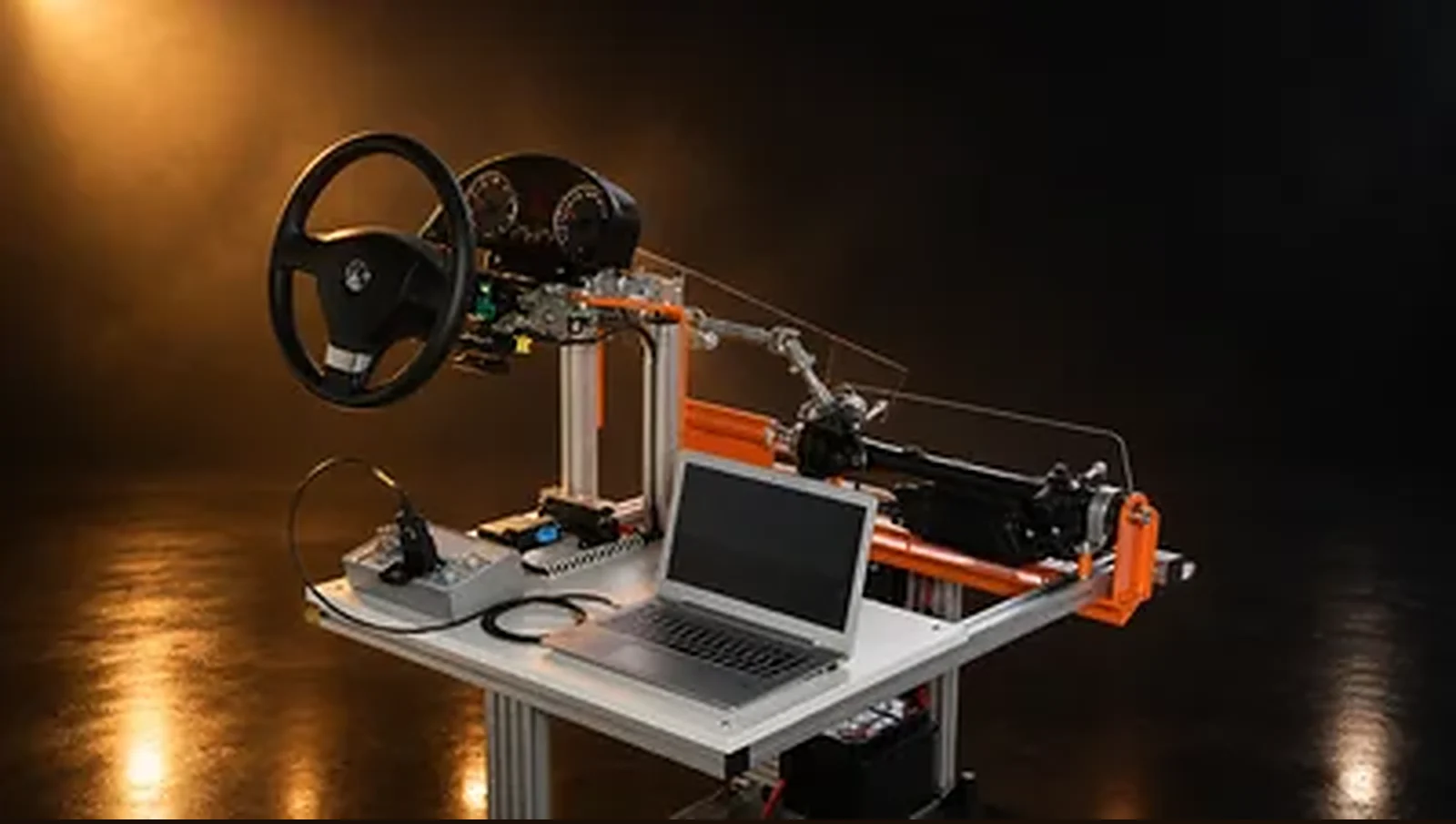
Functional model of an original electromechanical power steering — steering angle, current draw and torque readable via OBD, 6 switches with 12 faults.
Four points where the Electromechanical Power Steering differs from a diagram — you measure on the trainer, not on the drawing.
A resistance pressure cell partially increases steering forces — the effort becomes tangible.
Measured-value blocks for steering angle, current draw and torque with standard workshop diagnostic tools.
6 toggle switches with 12 faults, 4 mm pin-outs on all components.
Dual drive pinions exposed behind acrylic glass, plus the original instrument cluster and CAN communication.
Functional model of an original electromechanical power steering. Steering angle, current draw and torque are checked and displayed in the measured-value blocks with standard workshop diagnostic systems via the OBD interface. A resistance pressure cell partially increases the steering forces. The rig has a control panel with ignition switch and OBD interface; a vehicle battery is required for power.
| Design | Mobile aluminium-profile trolley |
|---|---|
| Faults | 6 switches · 12 faults |
| Diagnostics | OBD interface |
| EQR level | 2, 3 |
| Manual | 56 pages · tasks · solutions |
| Dimensions (L × W × H) | 1020 × 950 × 1450 mm |
|---|---|
| Weight | 50 kg |
| Power supply | 12 V vehicle battery |
A demonstration takes about two hours. We set it up, show the tasks on the trainer and the course that goes with it. You will see right away whether it fits your training workshop.